

Quick answer: Backgammon is a two-player game in which each player moves fifteen checkers using dice. Bring your checkers into your home board, then remove them by bearing off. The first player to bear off all fifteen wins. Along the way, you can hit an exposed opposing checker and block landing points with two or more of your own.
Before looking for the best move, learn to answer three questions: Which way am I moving? Where does each die let me land? Do I have a checker on the bar? This guide introduces standard international backgammon. If you learned tavla at a family table in Türkiye, also read the section on agreeing local conventions.
1. Understand the board and set up the checkers
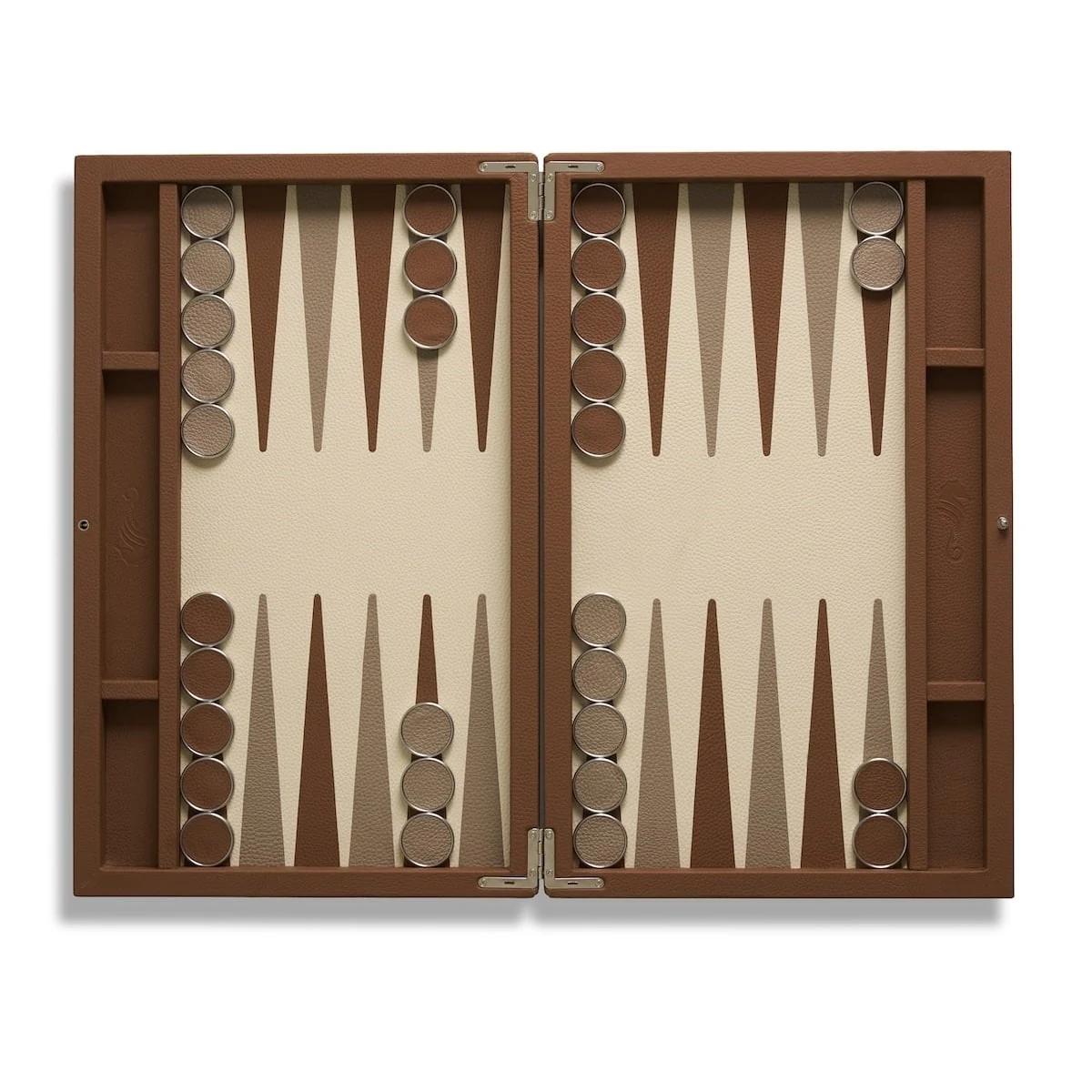
The board has 24 triangular points, arranged in four groups of six. Your final six points are your home board. The central divider, or bar, holds checkers that have been hit. Each player numbers points from their own home board: your 24-point is your opponent’s 1-point.
| Point | Checkers |
|---|---|
| 24 | 2 |
| 13 | 5 |
| 8 | 3 |
| 6 | 5 |
Check the total: 2 + 5 + 3 + 5 = 15. Your opponent sets up from the opposite perspective. The two colours travel in opposite directions. Rather than memorising “left” or “right”, trace your route from your 24-point down to your 1-point. Setup and numbering reference.
2. Decide who starts
Each player rolls one die. Reroll ties. The player with the higher number moves first, using the numbers already showing on both dice rather than rolling again. Players then alternate turns, rolling two dice each time.
3. Treat the dice as separate moves
A checker may land on an empty point, a point occupied by your own checkers, or a point with exactly one opposing checker. Two or more opposing checkers close a point. You do not need every point you pass over to be empty: the landing point for each individual die must be legal.
Try this: With a 4–2 roll, move one checker four points and another two. Alternatively, move the same checker in two stages: four then two, or two then four. Both the intermediate landing and the final landing must be legal. Calling the roll “six” does not let you skip two blocked intermediate choices.
Doubles give four moves of the same number: 3–3 means four separate three-point moves. Use both dice if possible. If only one number can be used, use it. If either number can be played individually but not both together, use the higher number. With doubles, play as many of the four moves as legally possible. If none is legal, your turn ends. USBGF movement rules.
4. Hit blots and enter from the bar
A lone checker is a blot. Landing on an opposing blot sends it to the bar. If any of your checkers are on the bar, entering them into your opponent’s home board takes priority over moving your other checkers.
Try this: You have one checker on the bar and roll 2–5. Check your opponent’s 2-point and 5-point as possible entry points. A point containing two or more opposing checkers is closed. Once your final barred checker has entered, play any remaining die legally. If a checker is still on the bar, you cannot move a checker elsewhere on the board instead.
5. Bear off after reaching your home board
All your remaining checkers must be on your own points 1–6 before you can bear off. A die can remove a checker from its matching point. If that point is empty and you have checkers on higher-numbered points, make a legal move from a higher point. If no checker is farther away, you may remove one from your highest occupied point. Bearing-off reference: Chris Bray’s beginner guide.
Compare two positions: If your farthest checker is on the 4-point, a 6 can take it off. But if you still have a checker on the 6-point, your 5-point is empty and you roll a 5, you must make the legal 6-to-1 move rather than remove a closer checker. If you are hit while bearing off, return that checker to your home board before bearing off again.
6. Understand wins, gammons and the cube
In standard international scoring, a normal win applies when the loser has borne off at least one checker. A gammon applies when the loser has borne off none. A backgammon applies when the loser has borne off none and still has a checker on the bar or in the winner’s home board. These results score one, two or three times the game’s value respectively.
The doubling cube tracks that value; it is not a movement die. Where doubling is permitted, offer it at the beginning of your turn, before rolling. A refusal ends the game at its previous value. Acceptance continues play at the new value and gives the accepting player ownership of the cube. In match play, the game immediately after a player first reaches one point short of the target is the Crawford game: the cube cannot be used in that one game. UKBGF introduction to tournament play.
Is Turkish tavla the same as international backgammon?
The basic checker game is closely related, but do not assume that every table follows identical scoring or procedures. Before you start, agree how the opening roll works, whether you will use a cube, whether triple wins count and what score ends the match. This guide does not claim that its international conventions are universal household traditions. In a tournament, follow the organiser’s published rules.
A short practice routine for your first game
- Set up and count each colour separately.
- Have each player trace their direction of travel.
- Read the dice aloud and check both landing points before moving.
- Point out one blot and one closed point, and explain the difference.
- Aim for legal, understood moves before trying to play quickly.
Frequently asked questions
How many checkers are there?
Fifteen per player, or thirty in total, on a board with twenty-four points.
Can checkers move backwards?
Not as an ordinary move. A hit checker returning through the opponent’s home board is following the re-entry rule, not choosing to move backwards.
Is there a five-checker limit on a point?
No. Standard backgammon does not impose that limit. Starting with five checkers on some points does not create a maximum stack size. Basic rules FAQ.
Can you play without money?
Yes. Count games won or play to an agreed points target. Money is not required.
Where to go next
For the social side of play, read our backgammon etiquette guide. When choosing equipment, explore what to look for in a backgammon set. A beautiful board can enrich the experience; the rules do not change with its price.
Sources checked: 14 September 2026. This introductory guide does not replace a tournament’s regulations.