

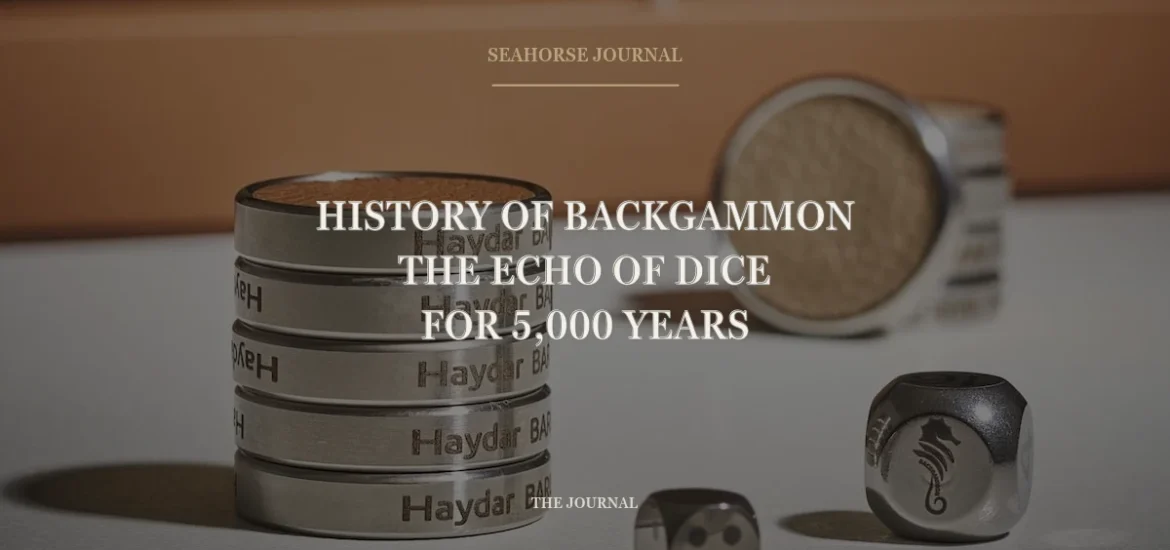
The deep, resonant sound of dice rolling across velvet is not merely the mark of a game, but the whisper of civilizations spanning millennia. The checkers gliding over polished wood follow in the footsteps of ancient kings, brilliant viziers, and emperors who shaped history. The history of backgammon is one of humanity’s most captivating pursuits: the search for a perfect balance between chance and strategy.
Today, this refined ritual sits at the heart of modern living spaces—yet its roots reach back to the cradle of civilization, nearly 5,000 years into the past.
First Steps in Ancient Mesopotamia and Along the Silk Road
When we trace the history of backgammon, the earliest widely cited clues lead us to the 3rd millennium BCE—toward ancient Mesopotamia and to the legendary site of Shahr-e Sukhteh (the “Burnt City”), within today’s borders of Iran. Archaeological excavations have revealed elegant boards carved from ebony and checkers fashioned from agate.
Sharing deep roots with games like the Royal Game of Ur, these early boards suggest something important: from the very beginning, backgammon-like games were not merely common entertainment, but an intellectual symbol of prestige—admired by nobles and the aristocracy.
A Duel of Mind and Fate: The Famous Persian Legend
The philosophical depth we associate with backgammon today is often tied to a celebrated Persian legend. According to the tale, an Indian ruler sends chess to the Persian king Khosrow I (Nushirvan) as a gift—challenging the Persians to decipher the game as proof of logic’s supremacy.
The king’s wise vizier, Bozorgmehr, quickly solves chess. Yet the response must be even more refined. Bozorgmehr argues that intellect alone is not enough—human effort (strategy) must meet the flow of the universe (fate/chance). And so, in this legend, he invents backgammon. Within this symbolic worldview:
Backgammon’s Symbolism: From the Board to Time, From Dice to Destiny
- The board represents one year (time).
- The 12 points on each side symbolize the 12 months—and together, the 24 hours of the day.
- The 30 checkers reflect the days in a month; their black and white colors represent night and day.
- The dice embody chance and destiny. What matters is not what you roll, but what move (strategy) you choose to make with it.
This is why backgammon is often seen as a distilled portrait of life itself.
The Roman Emperors’ Greatest Passion: Tabula
Carried from Persian courts into the Roman Empire, the game took on the name Tabula (“board”) and became a fixture of aristocratic life. The passion of Emperor Claudius for the game was said to be so great that he even had a wooden board installed in his carriage so he could play while traveling.
Across Rome’s marble courtyards, the sound of dice echoed—helping cement backgammon’s status as a true “game of kings” across Europe.
Redefining the “Game of Kings” with Seahorse
From the mystery of ancient Mesopotamia to the splendor of Rome, the history of backgammon finds new life today in Seahorse Backgammon’s production philosophy.
You can read our philosophy here.
We take this 5,000-year legacy and blend it with the calm, enduring aesthetics of the Mediterranean. Shaped by a marine-grade, first-quality wooden body and the flawless workmanship of premium leather, each Seahorse set offers far more than a game. It carries that same privileged tactile experience once reserved for Persian viziers and Roman emperors—reimagined for the modern language of luxury.
A heirloom that is not put away when the game ends, but displayed—then passed down from generation to generation… The dice have been cast. Now it’s your turn to experience this ritual of elegant strategy with the Seahorse distinction.
Frequently Asked Questions
How old is backgammon?
The history of backgammon is commonly traced back around 5,000 years, to early board-game traditions in Mesopotamia and surrounding regions.
What is Tabula?
Tabula is one of the names used in the Roman period for a backgammon-like game that became popular among the aristocracy.
Why is backgammon considered a game of chance and strategy?
The dice introduce chance, while planning, positioning, and risk management define strategy. The game lives in the tension—and harmony—between the two.